Open the exact family listing to compare the live price, availability, delivery, seller, and returns.
Choose a home or professional grooming table by animal size and behavior, non-slip usable surface, rated load, fixed or adjustable height, base stability, rotation or folding locks, edge and foot grip, arm geometry, restraint-loop limits, tool and cord placement, lifting, cleaning, and when a groomer is safer.
Prepared by the PawSelect Picks editorial deskUpdated August 10, 2026
Quick answer
The practical answer
Choose a table whose usable surface supports the animal's full standing stance, whose base stays stable during turning and shaking, and whose working height avoids repeated bending. The grooming arm and loop are positioning aids—not fall arrest or permission to step away. Keep one hand and continuous attention on the animal, control tools and cords, and use a professional for fearful, aggressive, painful, very large, or medically fragile pets.
Common buying question
Which pet grooming table should I buy for a dog or cat at home, and what size and restraint setup are safe?
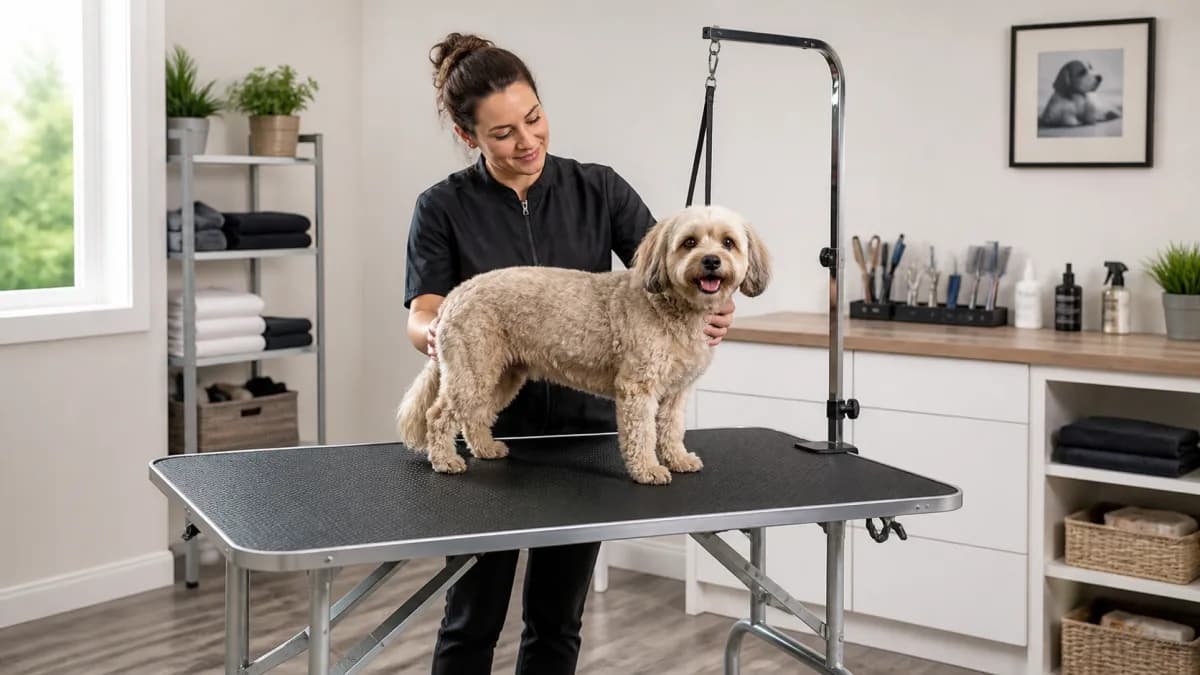
Original editorial image for category, fit, and use context; verify the exact linked product appearance and configuration on the retailer page.
Decide whether table grooming is appropriate
Consider size, age, mobility, pain, respiratory or cardiac disease, fear, aggression, bite history, and response to feet, face, clippers, dryers, and restraint. A table can improve handler posture and access but raises fall consequences. Seek veterinary or qualified professional grooming help when the animal is medically fragile, highly distressed, aggressive, very large, or cannot stand comfortably.
Fit the full standing stance
Measure from front toes to rear toes in a relaxed standing position and the width needed to rebalance. Compare those dimensions with usable non-slip surface, not the product's outer edge. Small rotating tabletops can provide access around a calm small pet; larger dogs need a rectangular platform that supports the complete stance without paws crowding an edge during turning or shaking.
Stability and working height come before accessories
Set the table on a level, dry, non-slip floor and verify all feet, locks, clamps, folding legs, or rotating stops. Load rating is necessary but does not describe dynamic movement. Choose a height that lets the handler reach the animal without unsafe bending or overreaching. For heavy dogs, a low electric or hydraulic table may reduce lifting risk better than a portable fixed-height model.
Use the arm and loop only as supervised positioning aids
Follow the exact instructions for arm or post attachment, height, loop placement, and quick release. A grooming loop is not fall protection and must never support a hanging animal. Do not leave the pet unattended even for a moment. Keep enough slack for comfortable breathing and standing while preventing sudden jumps, and maintain hands-on control throughout the task.
Control tools, electricity, cleaning, and session length
Arrange shears, blades, brushes, dryers, products, towels, and cords so the pet cannot step on, chew, knock, or become entangled in them. Keep electrical equipment away from water and follow its instructions. Work in short stages, reward calm behavior, stop before fatigue or escalating distress, and clean and dry the surface, loop, and tools between animals as appropriate.
Current Amazon option
Check this exact product
Master Equipment TP160 18-Inch Small Pet Grooming Table in Blue
ASIN
B001VPAEQS
Brand
Master Equipment
Listing checked
8/10/2026
Compare the current title, ASIN, variant, seller, stock, shipping, price, and return path before ordering.
Exact blue Master Equipment TP160 small-pet table anchor; verify 18-inch selection, included arm and loop, seller, warnings, and availability.
Public owner context
Questions to answer before buying
Community discussions help surface installation, fit, maintenance, and failure questions. They are anecdotal context, not product specifications or a substitute for current instructions.
Used to identify recurring questions about table size, arms, stability, home use, and brand options; comments do not substitute for handling training or product instructions.
Research notes
How we evaluated these choices
1.Measure the animal's normal stance and observe handling, mobility, fear, jump, and bite risk before selecting equipment.
2.Verify the exact table dimensions, load, feet, locks, arm, loop, assembly, maintenance, and warnings from the manufacturer.
3.Set up on a level dry floor, rehearse lifting and tool placement without the animal, and keep an assistant when needed.
4.Use continuous hands-on supervision, short sessions, positive handling, and professional or veterinary help when risk exceeds skill.